Somewhere around four months postpartum, a student messaged me: "My weight is back to normal but none of my bras fit. Not the cups — the band. Did my ribcage… grow?"
Short answer: yes, kind of. And if that's you, you're in extremely good company. A wider ribcage — often with lower ribs that visibly "flare" up and out — is one of the most common changes I see in postpartum bodies, and one of the least talked about. It even has a name: rib flare.
Here's the good news up front: rib position is trainable. Your ribcage isn't broken and it isn't permanent scaffolding — it's a dynamic structure that responds to breath, posture, and load. But to change it, you need to understand why it moved in the first place. So let's start there.
First, meet your pressure system
Your core is not your abs. Your core is a pressurized container — and I want you to picture it like a canister:
- The lid is your diaphragm — the dome-shaped breathing muscle that sits up under your ribs.
- The base is your pelvic floor — the sling of muscles at the bottom of your pelvis.
- The walls are your deep abdominals and the small stabilizing muscles of your back.
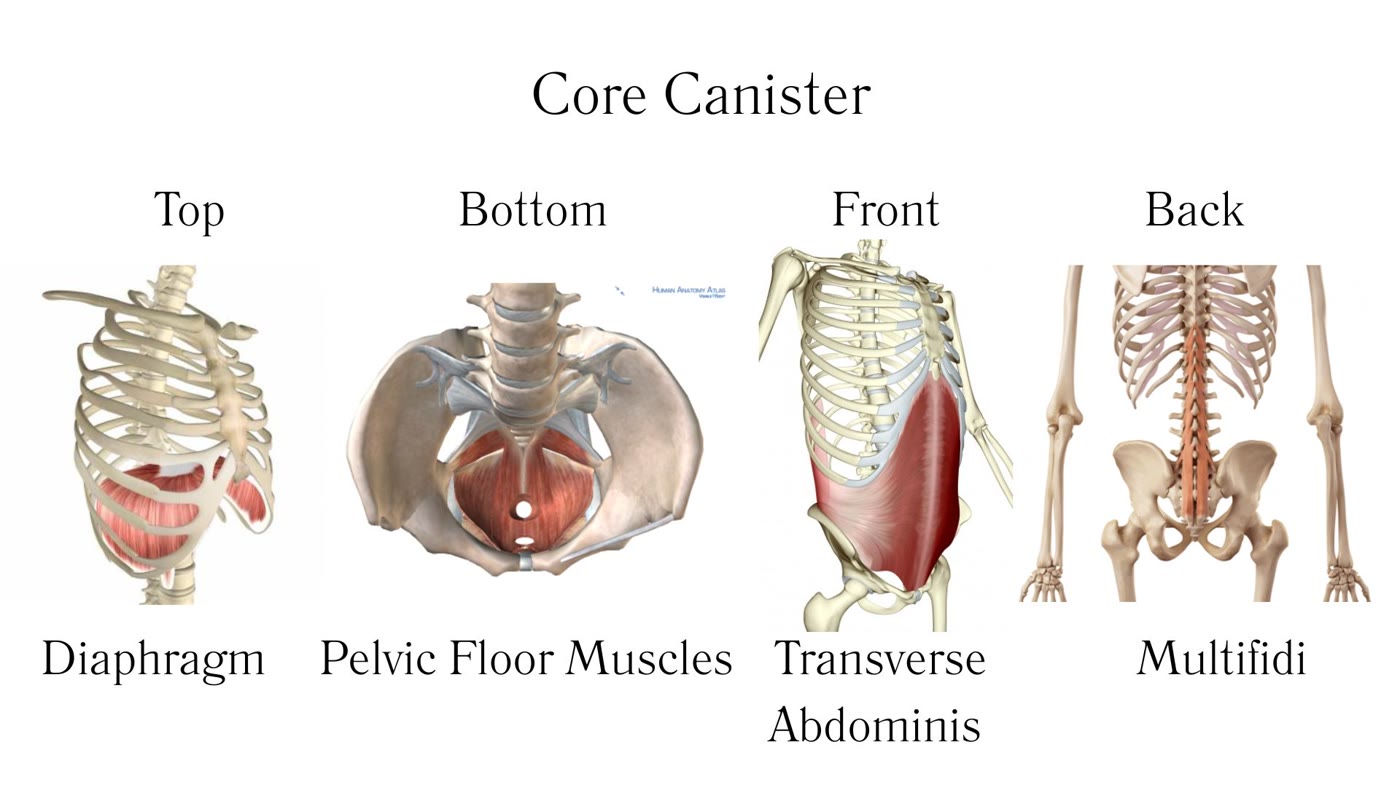
The core pressure system — diaphragm, deep core, and pelvic floor, moving together
These three parts move together, all day, with every breath. When you inhale, your diaphragm flattens and descends, your ribs swing up and out (imagine a bucket handle lifting), and your pelvic floor lengthens downward to make room. When you exhale, everything recoils: diaphragm domes back up, ribs come down and in, pelvic floor rebounds like a slow trampoline.
Diaphragm and pelvic floor, moving as a piston. Thousands of times a day. This rhythm is what manages the pressure inside your trunk — and managing that pressure well is what protects you from the postpartum issues you've probably heard about: leaking, heaviness, doming through your midline.
Your ribcage isn't just where your bra sits. It's the lid of your entire core pressure system.
What pregnancy does to your ribcage
Now put a growing baby inside that canister.
Through the second and third trimesters, your uterus expands upward and your organs shift to make room. Your diaphragm gets pushed up and can't descend as far — which is why stairs left you breathless in month eight. To compensate, your ribcage does something remarkable: it widens. The lower ribs swing up and out and, functionally, they can get stuck there. Your body ends up living in a low-grade "inhale" position around the clock — ribs open, diaphragm flattened, even when you're not breathing in.
That served a purpose. It made room for your baby and let you keep breathing. Your body did exactly what it was supposed to do.
The catch is that birth doesn't automatically reverse it. The baby is out, but the rib position, the breathing pattern, and the stiffness through your side body and upper back that developed over those months? Those often stay — until you retrain them.
Why it lingers
Pregnancy hormones (relaxin, progesterone, oestrogen) increase connective-tissue laxity, which allows the ribcage to expand more than it otherwise could. Postpartum, muscles that pull the ribs down and in on the exhale — your internal obliques among them — have been lengthened and underused for months. The ribs don't stay flared because the bone changed shape; they stay flared because the system that closes them isn't doing its job yet. That's exactly why it's trainable.
Why rib flare matters (it's not about the bra band)
If rib flare were purely cosmetic, I'd tell you to buy new bras and move on with your life. But remember the canister: if the lid is tilted open, the whole pressure system runs poorly.
When your ribs sit flared and your diaphragm stays flattened:
- Your breath goes shallow. You start breathing up into your chest, neck, and shoulders — hello, neck tension you keep blaming on the baby carrier.
- Your deep core can't pre-tension. The deep abdominal system fires off your exhale. No real exhale, no real activation — which is a hidden reason core work can "not feel like anything" postpartum.
- Pressure goes looking for an exit. Poorly managed intra-abdominal pressure shows up as coning or doming along your midline, a feeling of heaviness in your pelvic floor, or leaking when you sneeze, laugh, or jump.
- Your posture compensates. Flared ribs usually travel with a thrust-forward pelvis and gripped lower back — the classic postpartum "stack" that makes your back ache by 4pm.
This is why I care so much about rib position in every single class I teach, whether it's labeled a rib flare class or not. Ribs over pelvis is the home base every other skill builds on.
The two kinds of rib flare
Not all rib flare is the same, and telling them apart changes what you should work on.
1. Positional rib flare
This is a posture story. Your ribs are capable of stacking over your pelvis — they just don't, out of habit. Months of pregnancy posture, then months of feeding, rocking, and carrying, teach your body a shape: hips pressed forward, bum tucked, upper back rounded, ribs popped open to counterbalance.
The test: stand sideways at a mirror. Exhale slowly and see if you can gently melt your lower ribs down toward your front hip bones without slumping. If the flare mostly disappears when you do this, your ribs move fine — your default position is the thing to train. That's genuinely good news, because posture patterns respond quickly to consistent cueing.
2. "Stuck open" rib flare
Sometimes it's more than habit. If your ribcage has been living in that inhale position for a long time, the angle of your lower ribs (clinicians measure this as the infrasternal angle — roughly 90° is typical, and a flare is generally called when it's well beyond that) can stay wide even when you actively exhale and try to stack. The muscles that should close the ribs down have lost the skill.
The test: lie on your back, knees bent. Take a full, slow exhale — all the way out, like fogging a mirror until you're empty. Feel whether your lower ribs actually come down and in. If they barely move no matter how completely you exhale, you're likely dealing with this type — and posture cues alone won't fix it. You need to retrain the exhale itself, usually with some added feedback like hands or a strap.
Most postpartum women have some blend of both. Which is convenient, because the starting point for both is the same.
Where to start: the 360 breath with rib feedback
Everything I teach starts with the breath, and rib flare is the clearest example of why. You cannot stretch or crunch your way out of a breathing pattern. You have to breathe your way out of it.
Try This — 5 minutes
Rib-closing 360 breath
- Set up: Sit tall on a chair or lie on your back with knees bent. Wrap your hands around your lower ribs — fingers in front, thumbs toward your back. (A yoga strap or long towel wrapped snugly around the lower ribs works even better for feedback.)
- Inhale through your nose and send the breath wide — into your hands, into the strap, into your side and back ribs. Not up into your chest, not just down into your belly. Think of your ribcage expanding 360 degrees, like an umbrella opening.
- Exhale slowly through pursed lips, and this is the important part: feel your ribs slide down and in, away from your hands. Gently assist with your hands or the strap — a light hug inward and downward as you empty out completely.
- At the very end of the exhale, notice the subtle tension that wraps around your waist like a corset. That's your deep core switching on — no crunch required.
- Repeat for 5 slow breaths, 2–3 times a day. Before feeds is an easy anchor.
If you feel pressure bearing down into your pelvic floor, or you're bracing your neck to breathe, make the breath smaller and slower. Effort is not the goal — direction is.
Five breaths sounds like nothing. But you take upwards of 20,000 breaths a day — every one of them is currently rehearsing either the flared pattern or the stacked one. Shift even a fraction of them and you are doing more corrective work than any 45-minute workout could.
Then: stack, strengthen, integrate
Once the breath is working, rib flare work progresses in the same order I build every postpartum program:
- Stack your posture. Practice ribs-over-pelvis in the positions you actually live in — standing at the changing table, carrying the car seat, sitting to feed. Unglue the hips-forward, ribs-open stance. (This is also, not coincidentally, the fix for the "mom butt" posture — the tucked pelvis and the flared ribs are two ends of the same problem.)
- Strengthen the closers. The muscles that knit your ribs down and in — especially your obliques working with your deep abdominals — need direct, progressive work: think side-lying breath work, deadbugs with a full exhale, and rotation work once your midline is ready.
- Integrate under load. Finally, the new rib position has to survive real life: lifting, carrying, reaching, eventually impact. This is where full-body strength work with breath-led cueing turns a drill into a default.
In the motherbuilt app, this is literally the arc of the 12-week Rebuild program — reconnect, rebuild, reinforce — and there's a dedicated Fix Your Rib Flare class when you want to target it directly. If you're pregnant and reading this: the 360 breath is taught from week one of Birth Ready, because the best time to manage rib position is while it's changing.
What rib flare work won't do
I want to be straight with you, because this corner of the internet is full of before-and-afters that overpromise.
Breath and core training can meaningfully change your rib position, your breathing mechanics, your pressure management, and often how your torso looks and feels. What it can't do is guarantee your ribcage returns to its exact pre-pregnancy circumference. Some widening of the bony structure can persist — you grew a human; some souvenirs are structural. A slightly wider band size with a strong, well-pressurized, pain-free core is a win, not a failure.
You're not getting your body back. You're building something better. I mean that literally here: a ribcage that moves with your breath and stacks over your pelvis is better than what most of us had before pregnancy — most people have never trained this at all.
When to see a professional
I'm a fitness specialist, not a physical therapist — and there are situations where you want clinical eyes on this. See a pelvic floor physical therapist if you have rib pain (not just tightness), pain with breathing, a midline that cones with everyday movements, ongoing leaking or heaviness, or if consistent breath work for 4–6 weeks changes nothing. The exercises here work alongside clinical care beautifully — they're not a replacement for it.
FAQ
How long does it take to improve rib flare postpartum?
With consistent daily breath work and posture practice, most women feel a difference in breathing and rib mobility within 2–4 weeks, with visible positional change over 2–3 months. Stuck-open patterns take longer than positional ones. Consistency beats intensity — five breaths several times a day outperforms one long weekly session.
Can I fix rib flare years after having kids?
Yes. The breathing pattern and muscle skill that hold ribs flared are trainable at any point — 6 months or 6 years postpartum. The early postpartum window is a head start, not a deadline.
Is rib flare the same as diastasis recti?
No, but they're neighbors. Both are pressure-system issues: diastasis affects the connective tissue down your midline; rib flare is about rib position and breathing mechanics up top. They frequently show up together, and the same breath-first training helps both.
Will a waist trainer or rib belt fix it?
Passive compression doesn't teach your muscles anything, and cinching hard can push pressure down onto your pelvic floor. A light strap used during breath work for feedback is useful; wearing compression all day as a fix is not.
Can I work on rib flare while pregnant?
Yes — 360 breathing and gentle posture stacking are appropriate throughout pregnancy and make the postpartum work dramatically easier. Skip the aggressive rib-closing assistance while pregnant; your ribs are supposed to be expanding right now. And as always, check with your provider.
Want this done for you, in order?
The Rebuild starts exactly here — breath, ribs, pelvic floor — and builds week by week to full-body strength. Your first week is free.
Start Week One
Em is a prenatal and postpartum fitness specialist and the founder of motherbuilt. She teaches technique-first programs covering pregnancy (weeks 1–40) and the postpartum rebuild. Find her on Instagram at @birthreadymama.