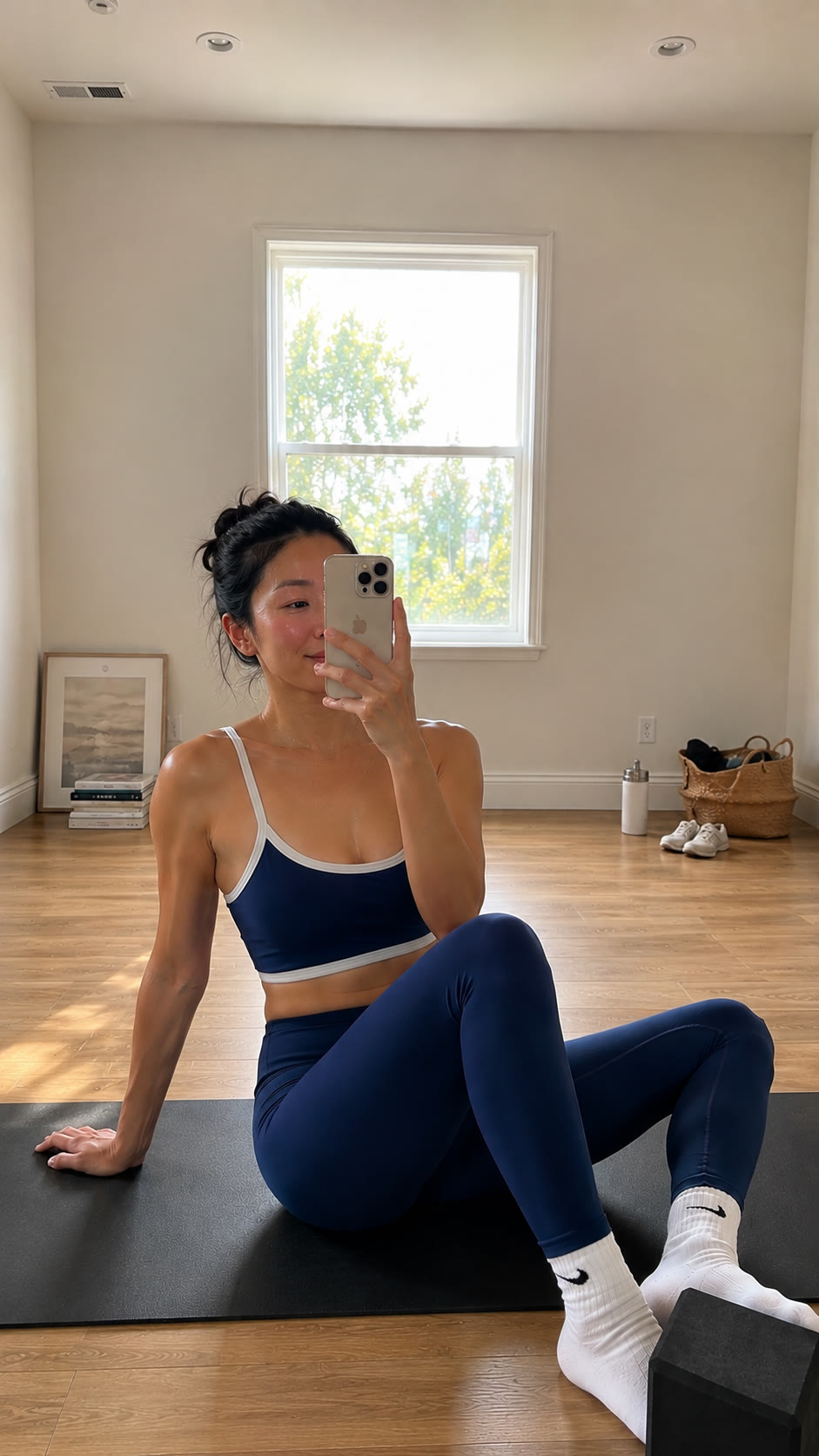
"Mom butt" gets talked about like it's an aesthetic problem — a flattening, a deflating, something to be embarrassed about at the pool. I want to reframe it completely: mom butt is a function problem with an aesthetic symptom. And if you treat the symptom (more squats! more lunges!) without fixing the function, you mostly just get better at squatting with the wrong muscles.
How pregnancy switches your glutes off
Your glutes are the biggest, most capable muscles in your body — they don't atrophy for no reason. Pregnancy runs a very specific de-training program on them:
The waddle. As your belly grew and relaxin loosened your joints, your gait widened and your feet turned out — the classic pregnancy waddle. Externally rotated, wide-stance walking lets you balance a bump, but it hands the work to your outer-hip gripping muscles (like the piriformis) and takes it away from the glute max and glute med. Months of thousands of steps a day in that pattern is a lot of practice for the wrong muscles.
The tuck. Postpartum, most of us swing the other way: pelvis tucked under, hips pressed forward, standing in "tired mom lean" while holding a baby. A tucked pelvis puts the glutes in a shortened, slack position where they literally cannot produce force well. It also — same posture chain as rib flare and the flat-back problem — compromises your deep core and pelvic floor. The tucked butt and the flared ribs are two ends of one collapsed stack.
The grip. When glutes go quiet, something must stabilize the pelvis — so the deep external rotators, hip flexors, and low back start clenching around the clock. Tight, gripping muscles feel "strong," but tight is not strong. It's why your hips feel like concrete and your butt looks like it retired.
Tight doesn't mean strong. A gripping hip and a sleeping glute usually live in the same body.
The four signs your glutes stopped firing
Try This — 2-minute self-check
Are your glutes actually working?
- Look at your feet in a mirror, standing relaxed. Turned out like a duck? Arches collapsed inward? That's often the external-rotator grip covering for lazy glutes.
- Do a slow bodyweight squat facing a wall. Do your knees shoot forward and your tailbone tuck under at the bottom? That's quads and hip flexors doing glute work. A working squat sends the hips back, tailbone proud until deep in the range.
- Balance on one leg for 30 seconds. Does the opposite hip drop, or your whole pelvis sway sideways? That's glute med weakness — the side-stabilizer that keeps your pelvis level with every single step.
- Walk slowly and feel: do your hips sway side to side, a leftover waddle? Same culprit.
Bonus awareness drill: a few times a day, squeeze your glutes, then fully relax them. Many moms discover they're either never using them or never releasing them — both are information.
Why "just squat more" fails
Load follows patterns. If your default pattern is tucked-pelvis, knees-forward, quads-first, then adding reps and weight to your squat strengthens that pattern. You get stronger quads, crankier knees, a grippier low back — and the glutes keep sleeping through the whole thing. This is why women squat for months and see everything change except the thing they wanted.
The fix isn't a magic exercise. It's a sequence: position → activation → strength → integration.
Step 1: Un-tuck (position)
Stand with your ribs stacked over an untucked, neutral pelvis — tailbone neither clenched under nor flared way back. You can't strengthen a muscle you're standing on top of. This is posture homework, done at the changing table and the kitchen counter, and it's the same neutral we build on the floor here.
Step 2: Wake them up (activation)
Low-load, high-attention work that re-establishes the mind-muscle line: glute bridges with a full exhale at the top, clamshells with alignment cues (sloppy clamshells train the grippy rotators — the ones you're trying to retire), side-lying lifts, fire hydrants, donkey kicks. The question during every rep isn't "did I complete it" — it's "did my glute do it."
Step 3: The direction nobody trains (internal rotation)
Here's the piece missing from almost every "grow your glutes" program: after months of external-rotation dominance (the waddle, the turned-out feet), your hips have usually lost internal rotation — and with it, balanced pelvic mechanics. Training internal rotation (adductor work, knees-in-feet-out drills, 90/90 transitions) restores the pelvis's full movement menu, releases the gripping external rotators, and — bonus that surprises everyone — often reduces pelvic floor heaviness, because balanced hips stop hanging tension on the floor below them. Strong adductors and a working glute med are teammates, not rivals.
Step 4: Load and integrate (strength)
Now squats work. Hip hinges, single-leg work (low lunge, high lunge, step-ups — most of life happens on one leg), lateral work for the glute med, goddess squats, and eventually hip thrusts with real load. Same exercises the internet prescribed on day one — they just land on muscles that are finally home to receive them.
Why this matters beyond the mirror
The glute max holds your pelvis upright; the glute med keeps it level on every step; together they take load off your low back, knees, and pelvic floor. Weak glutes are quietly behind an enormous amount of "mom" low back pain, hip pain, and even leaking — research on hip strength and pelvic floor function keeps pointing the same direction. Rebuild the function and the shape follows; chase only the shape and neither shows up.
FAQ
How long until I see a difference?
Activation and posture changes: days to weeks — you'll feel your glutes in exercises almost immediately once position is fixed. Visible shape change: 8–12 weeks of consistent progressive loading. The felt change is the leading indicator; trust it.
Can I work on this while pregnant?
Absolutely — glute strength during pregnancy is protective (posture, back pain, SI joint pain) and makes the postpartum rebuild dramatically shorter. The trimester programs train it throughout, waddle notwithstanding.
Squats hurt my knees. Is that related?
Very likely — knees-forward, quads-first squatting overloads the knee while the glutes coast. Fix the hinge (hips back first) and activate the glutes beforehand, and most mom-knee squat pain improves. Pain that persists deserves professional eyes.
Is "mom butt" the same as a weak pelvic floor?
Different muscles, same neighborhood, deeply connected. The tucked posture that flattens your glutes also puts your pelvic floor in a poor position, and gripping hips hang tension on it. It's common to improve leaking and heaviness through hip and glute work — without a single extra kegel.
Wake them up in order.
The "Mom Butt" class and the strength phases of the postpartum program run this exact sequence — position, activation, rotation, load. First week free.
Start Week One
Em is a prenatal and postpartum fitness specialist and the founder of motherbuilt. She teaches technique-first programs covering pregnancy (weeks 1–40) and the postpartum rebuild. Find her on Instagram at @birthreadymama.