Here's a story I hear over and over: she leaks a little when she sneezes, mentions it at an appointment, gets told to do kegels. She does them — diligently, at red lights, like the internet says. Months later: same leaking, plus a new sense that her body is failing her at something that was supposed to be easy.
She didn't fail. The prescription did. Because "squeeze a muscle repeatedly" is not how you train a muscle group whose actual job is a coordinated cycle of lengthening, recoiling, and bracing — timed to your breath, against the pressure of everything you do. Let's talk about what your pelvic floor actually does, why squeeze-only training so often disappoints, and what a complete approach looks like.
What your pelvic floor actually is
Your pelvic floor is a dome-shaped sling of muscle and connective tissue spanning the base of your pelvis. It has several jobs at once: supporting your organs (bladder, uterus, rectum) against gravity and pressure, controlling your continence, contributing to sexual function, and — the part almost nobody mentions — acting as the floor of your core pressure canister.
That last job is the key to everything. Your diaphragm (the lid) and pelvic floor (the base) move together like a piston: inhale, both descend and lengthen; exhale, both rise and recoil. Every breath, all day. Which means your pelvic floor isn't a light switch you clench on and off — it's a spring in constant, rhythmic motion, absorbing and returning force thousands of times a day. (If you've read my rib flare piece, you already know this canister — same system, bottom floor.)
A healthy pelvic floor isn't a strong clench. It's a responsive spring — able to lengthen fully, lift promptly, and match its effort to the moment.
Why kegels alone so often fail
To be fair to the kegel: the research behind pelvic floor muscle training is genuinely strong — a Cochrane review spanning well over a hundred trials supports it as first-line treatment for stress urinary incontinence. Done well, pelvic floor training works. The problem is what "doing kegels" becomes without instruction:
Problem 1: Many postpartum pelvic floors are tight, not weak. This is the big one. A pelvic floor can hold excessive resting tension — from guarding after birth trauma, from chronic stress, from years of "engage your core!" fitness culture, from gripping against a heavy postpartum body. A tense muscle held at 80% all day has almost no range left to respond when a sneeze demands 100%. It fails not from weakness but from having no headroom — and prescribing more squeezing to that floor is like treating a clenched jaw with gum. Symptoms of an overactive floor overlap confusingly with a weak one: leaking, urgency, incomplete emptying, pain. Which is why blind squeezing makes some women worse.
Problem 2: Squeeze-only training skips the lengthening half. A muscle's usable strength lives across its full range. If you only ever practice the "up" and never the full, soft "down" (the release on the inhale), you're training half a muscle — and birth, ironically, demands the down: your pelvic floor's job during delivery is to open. This is exactly why the breath training in my prenatal program spends so much time on the inhale-release.
Problem 3: Isolated squeezing never meets real life. Your leak doesn't happen lying quietly on a mat. It happens mid-sneeze, mid-jump, mid-lift — moments of sudden pressure. A pelvic floor trained only in isolation, never coordinated with breath and movement and load, is a musician who only ever practiced scales alone and then gets shoved on stage with the orchestra.
The better model: the elevator
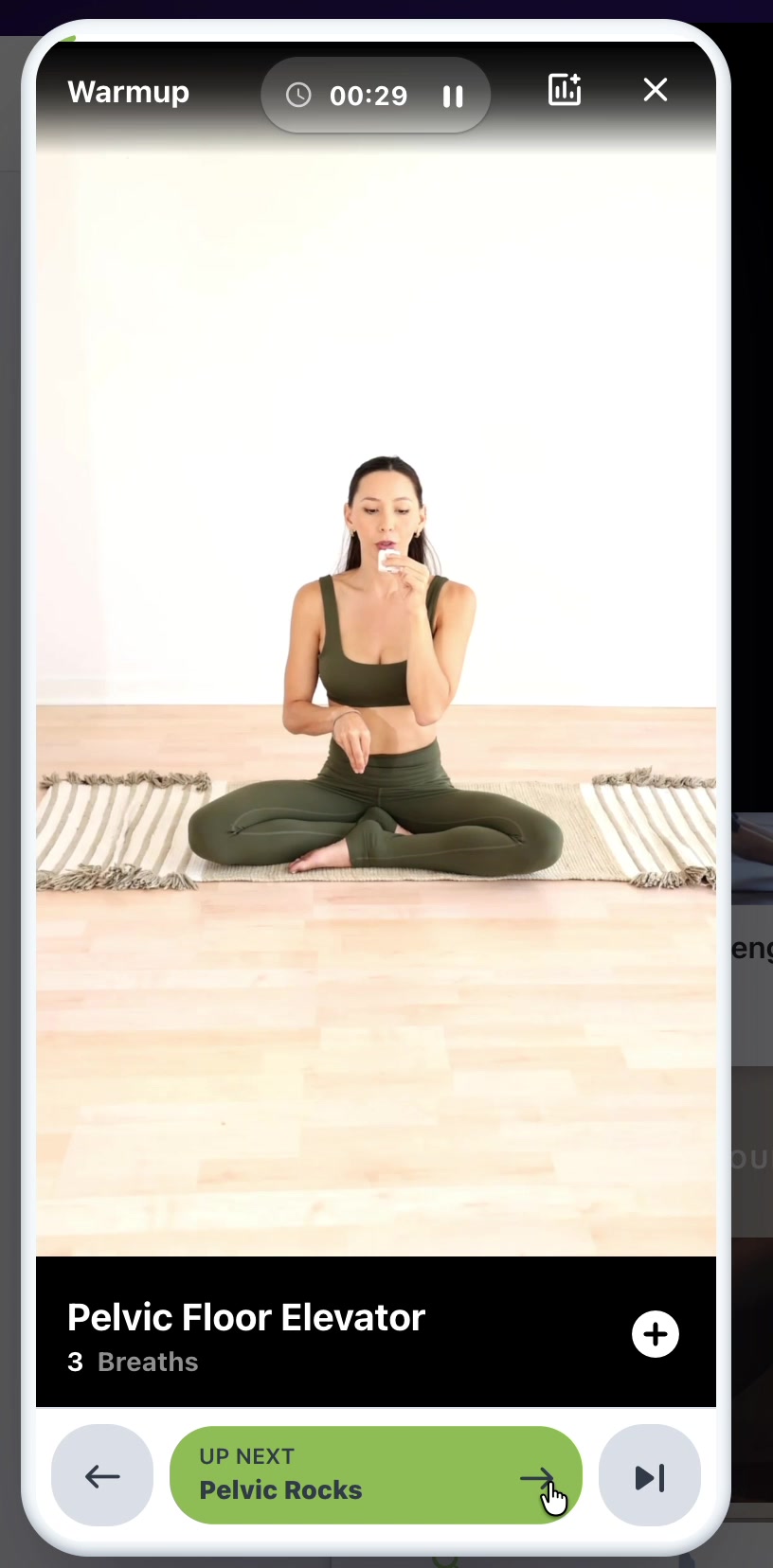
Here's the cue I teach in place of "squeeze": your pelvic floor is an elevator in a three-story building.
Try This — 5 minutes
The pelvic floor elevator
- Set up: Sit tall on a firm chair so you can feel your sit bones, or lie on your back with knees bent. Take a few slow 360 breaths to settle the system.
- Ground floor: On a slow inhale, let the elevator descend — soften and release your pelvic floor completely. Imagine the space between your sit bones gently widening. No pushing or bearing down; just a full letting-go. For many women this step alone is revelatory — you may discover you've been holding the elevator at the second floor for years.
- Going up: As you exhale, lift the elevator to the first floor — a gentle gathering, like picking up a blueberry with the muscles between your sit bones. Then, if you can, continue to the second floor — a slightly higher lift, up and into the body. No glute clenching, no jaw clenching, no breath holding: if your butt or shoulders join in, you've left the elevator.
- Coming down: Don't drop it — lower floor by floor with control on the next inhale, all the way back to a complete release at the ground floor.
- Repeat for 5–8 slow cycles, once or twice a day. The release matters exactly as much as the lift. If you can only do one thing well today, do the release.
Feel nothing at all? Very common early postpartum — the connection rebuilds with repetition. Feel pain, or heaviness that worsens? Stop and see a pelvic floor PT (more below).
From elevator to real life: the progression
The elevator is step one, not the program. From there, the training arc looks like this — and you'll recognize the pattern if you've read anything else I write, because it's the same arc your whole deep core follows:
- Coordinate with breath. The piston pattern — inhale lengthen, exhale lift — until it's automatic rather than effortful. This is Week 1 material in my postpartum program, and it's woven through every prenatal class too.
- Time it to effort. The exhale-lift arrives just before the demand: before you pick up the baby, before you stand from the couch, before the heavy part of a squat. This pre-tension is what catches the sneeze. (It even has a nickname in pelvic health circles: "the knack.")
- Load it. The pelvic floor is part of every squat, bridge, carry, and deadbug you do — once the coordination exists, your strength training is your pelvic floor training. This is why my mid and late phase workouts don't have separate "pelvic floor sections": by then it's integrated, where it belongs.
- Add impact last. Jumping, running, jump squats — the highest pressure demands come back once the spring can absorb and return force without symptoms. Earned, not scheduled.
The missing piece almost nobody trains: rotation
Here's the version of this that stops people mid-scroll: you could do a hundred kegels a day and still leak when you jump. One big reason is everything above — range, coordination, timing. But there's a second reason hiding in plain sight: your real life is rotational, and your training probably isn't.
Watch yourself for one day. You twist to lift the baby out of the crib. You rotate to clip the car seat. You reach across your body for the stroller, the groceries, the toddler making a break for it. You get up off the floor a dozen times, always spiraling through one side. Every one of those moments sends rotational force through your trunk — and your pelvic floor has to manage pressure while your obliques, hips, and ribcage are all in motion.
A pelvic floor trained only in symmetrical, stationary positions — lying still, both feet planted, squeezing — has never once practiced the situation it fails in. That's why rotational core work (think bear-position twists with a block, half-kneeling chops, side-lying rib rotations) is built into the mid and late phases of my postpartum program: it's where the elevator skill finally meets the twisting, reaching, asymmetric chaos of actual motherhood. If your kegels are diligent but your symptoms show up mid-movement, rotation is very likely your missing piece.
When kegels ARE the right tool
None of this makes the isolated contraction useless. If your floor genuinely lacks strength and coordination — very common after delivery — dedicated contract-relax practice is exactly right, and it's what the research supports. The corrections are simply: full range (release completely between reps), breath-coordinated (exhale on the lift), both endurance holds and quick flicks (your floor needs a marathon gear and a sneeze gear), and always as a phase on the way to integration, not a permanent red-light hobby.
When to see a professional
I'm a fitness specialist, not a pelvic floor physical therapist — and the pelvic floor is one area where individual, internal assessment genuinely changes the plan (it's the only way to actually know if your floor is weak, tense, or both). Book a pelvic floor PT if you have: pain (with intimacy, tampons, or exams), a feeling of vaginal heaviness or bulging, leaking that persists past the early months despite consistent training, urgency that runs your bathroom schedule, or any prolapse diagnosis or suspicion. If you're told "that's just motherhood" — it's common, not mandatory. Get the referral. My programs work alongside pelvic floor PT beautifully; several of my students found their PT because a class cue made them realize something deserved assessment.
FAQ
How many kegels should I do a day?
Wrong question, honestly — quality and range beat quantity. A useful dose: 5–8 slow elevator cycles with complete releases, plus a few quick flicks, once or twice daily, then progressively folded into movement. A hundred half-clenches at red lights train gripping, not function.
Should I do pelvic floor exercises while pregnant?
Yes — with equal emphasis on the release. Pregnancy loads the floor for months, and birth requires it to open. Breath-led training (both directions) is a core part of all three Birth Ready trimester programs, including breathing specifically for labor.
Is leaking after baby normal?
Common? Extremely. Normal-as-in-permanent? No. Stress incontinence responds well to proper training in most women — that's what the Cochrane evidence shows. Persistent leaking deserves a pelvic floor PT assessment, not resignation.
How do I know if my pelvic floor is tight rather than weak?
Clues: difficulty fully releasing in the elevator drill, pain or discomfort, urgency, symptoms that worsen with more squeezing. But honestly — this is the question an internal exam answers definitively, and it changes the entire plan. If in doubt, get assessed before training hard.
Do kegel trainers, weights, and apps help?
Biofeedback can help some women find the muscles, and that's legitimate. But devices bias you toward squeeze-only training — the release, the breath timing, and the integration under load are where most postpartum floors actually need the work, and no gadget trains those for you.
Your pelvic floor is on the team, not a solo act.
Every program I teach trains it the way it actually works — with your breath, your deep core, and eventually your barbell. First week free.
Start Week One
Em is a prenatal and postpartum fitness specialist and the founder of motherbuilt. She teaches technique-first programs covering pregnancy (weeks 1–40) and the postpartum rebuild. Find her on Instagram at @birthreadymama.