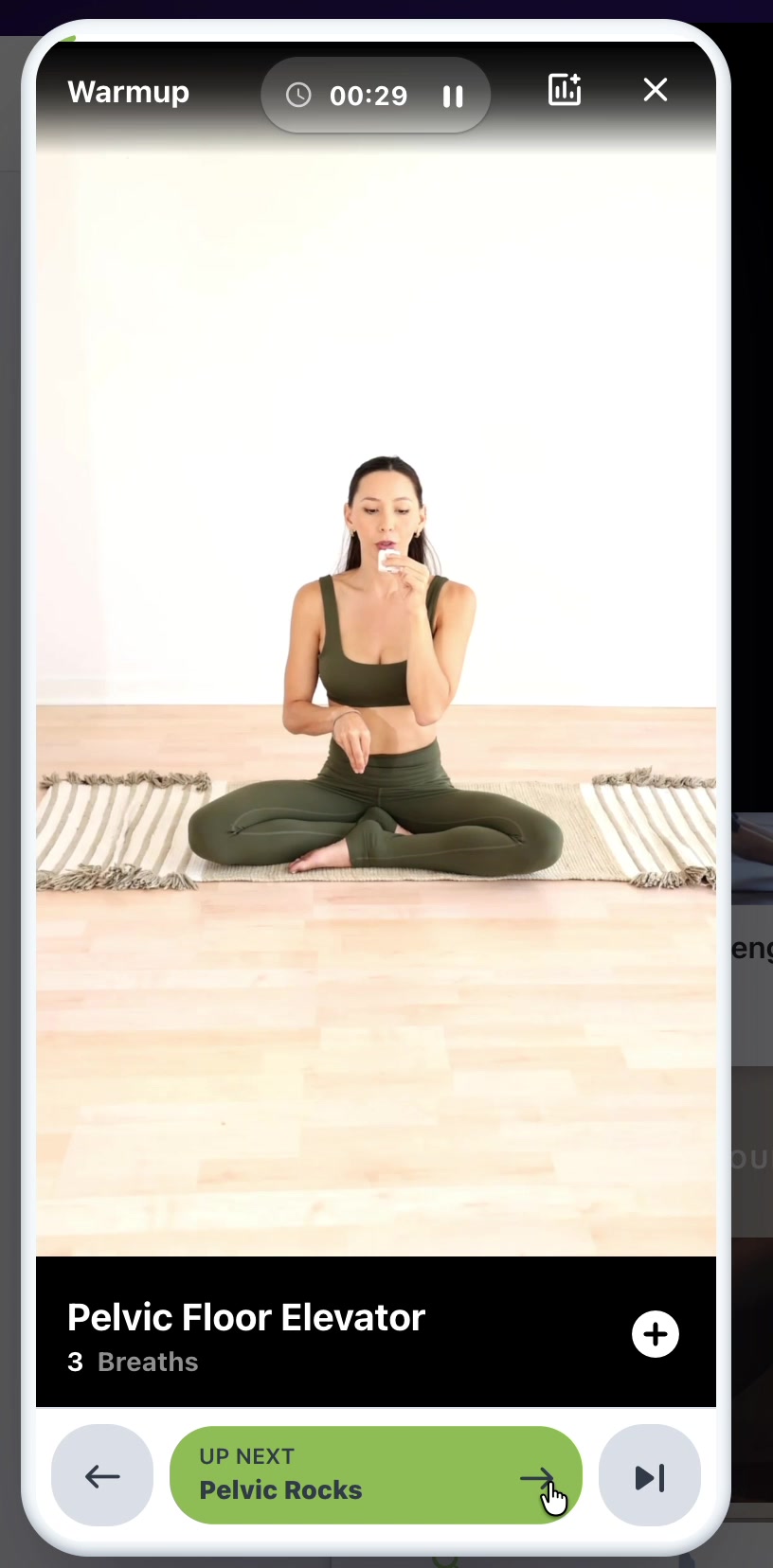
We don't often think about how we breathe — it's automatic, twenty-something thousand times a day, no supervision required. But during pregnancy and postpartum, your breath quietly becomes the most powerful tool you have.
When you inhale well, you lengthen and mobilize your pelvic floor. When you exhale well, you stabilize your spine and core — automatically, without "engaging" anything. Get this one pattern right and you manage pressure as your baby grows, push more effectively in labor, and recover faster postpartum. Get it wrong and the smartest core program in the world is built on scaffolding that wobbles.
Every single class I teach — prenatal, postpartum, and beyond — starts here. This post is why, plus the self-check and the guided practice to retrain it.
Meet the whole canister (all four walls this time)
If you've read anything else on this blog, you know I picture the core as a pressure canister. Here's the full anatomy of it:
- The top: your diaphragm — the thin, parachute-shaped muscle at the base of your ribcage, separating your lungs and heart from your abdominal cavity. Your primary breathing muscle.
- The bottom: your pelvic floor — the hammock of muscle supporting your pelvic organs (and, during pregnancy, your baby).
- The front and sides: your transverse abdominis (TVA) — your deepest abdominal muscle, wrapping around you like a corset.
- The back: your multifidus — the small, deep stabilizers running along your spine. The forgotten wall. When people say their back "just went out" bending over a crib, weak deep stabilizers plus bad pressure strategy is usually the real story.
These four aren't separate systems that need coordinating — they are one system. Your breath is the thing that runs it. Inhale: the diaphragm lowers, and the pelvic floor lengthens down to make room. Exhale: the diaphragm lifts, the pelvic floor recoils up, and the TVA wraps in to stabilize. A piston, cycling all day.
Pressure: the Goldilocks problem
The canister's job is managing intra-abdominal pressure — and both directions of failure cost you.
Too much pressure, poorly directed? Imagine pressing down on a balloon that's already full — eventually it bulges somewhere. In a body, "somewhere" is the path of least resistance: forward through the midline (coning, diastasis strain), down through the pelvic floor (leaking, heaviness, prolapse pressure), or through a weak point in the wall (hernia).
Too little pressure? Imagine lifting a heavy box with a slack center. No internal support means the strain shifts outward — into your hips, lower back, and pelvic floor, where it doesn't belong. That's where injury starts.
Pregnancy raises the stakes on both ends: your baby takes up more and more space, so the baseline pressure inside the canister rises and gets heavier month by month. That's why incontinence, back pain, and hip discomfort are so common in pregnancy — common, but not something you have to accept as debilitating. A well-run pressure system is the difference.
The downward spiral we don't want
Poor breath → poor pressure management → dysfunction (leaking, coning, pain) → tissues weaken and guard → even poorer breath. Each loop reinforces the last. The good news: the spiral runs in reverse too, and the breath is the cheapest place to break in.
The 3 breathing patterns (only one supports your core)
Try each of these right now — hands on, eyes closed if you like. Feeling the difference in your own body beats reading about it.
Pattern 1
Chest Breathing
The anxious breath
Try it: Place a hand on your chest. Inhale into your hand; exhale out. Twice more. Feel your chest rising, collarbones lifting? Notice how shallow it is — and how it can actually make you feel more anxious.
This breath bypasses the diaphragm almost entirely. Your neck and shoulder muscles do the lifting (hello, permanent shoulder tension), and the diaphragm–pelvic floor connection is cut out of the loop completely. It's the pattern stress puts us in — and for many of us, it quietly became the default.
Pattern 2
Belly Breathing
Relaxing — but pressure goes down
Try it: Hands on your belly. Inhale and let it inflate into your hands.
This one surprises people, because belly breathing is what most relaxation training teaches. It's better than chest breathing — the diaphragm is at least moving. But if the breath moves only into the belly and not into the ribcage and back, all that pressure gets directed downward — onto a pelvic floor that (pregnant or postpartum) is already carrying more load than usual. Fine for a few calming breaths; costly as an all-day default.
Pattern 3
360° Rib Breathing
The gold standard — diaphragmatic breath
Try it: Wrap your hands around your lower ribcage, fingers front, thumbs back. Inhale and try to feel expansion in all directions — side to side, front to back, top to bottom. Like an umbrella opening, or an accordion widening.
This distributes pressure evenly around the canister instead of dumping it up into the chest or down onto the pelvic floor. The diaphragm and pelvic floor move in sync. And when you exhale, everything recoils — ribs glide in, pelvic floor gently lifts, core engages reflexively. This is why we exert effort on the exhale in every class: the exhale is when your body naturally stabilizes.
If you've been a chest or belly breather, that's okay. This isn't learning something new — it's relearning what your body already knows.
Check your breath (30 seconds)
Place one hand on your chest and one on your belly. Just breathe naturally for a few moments — don't perform a "good" breath, let the real one show up. Then ask:
- Is your chest rising first?
- Is your belly inflating more than your ribs?
- Are your shoulders creeping up?
- Can you feel any movement in your lower ribs or your back?
Mostly chest or belly? Your pressure system is out of sync — which, given modern stress and the postures of pregnancy and baby care, describes most of us. It's not a character flaw; it's a pattern. And patterns retrain.
The guided practice
Try This — 3–5 minutes, daily
360° breathing practice
- Position: Sit upright with feet on the floor, or lie down with knees bent. One hand on your lower ribs, one on your low belly. Shoulders soft, jaw unclenched.
- Inhale through your nose. Feel your ribs expand into your hands in all directions — side to side, front to back, top to bottom. Let your belly softly follow, but don't push it out. You're creating space, not force. (Visual that helps: a balloon inside your ribcage inflating outward in every direction.)
- Exhale slowly through pursed lips — as if breathing out through a straw. Feel the ribs glide back in like an elastic band recoiling, and notice your pelvic floor gently rebound and lift, like the bottom of an elevator.
- Notice the connection. Inhale: diaphragm descends, pelvic floor softens and yields. Exhale: both lift. Don't do anything to the pelvic floor yet — just feel the system responding on its own. That subtle drop and rebound is your canister working.
- Check alignment: ribs gently stacked over pelvis (neutral, not tucked), breath moving down and wide, not just up.
- Repeat for 3–5 breaths, then change position: try the same breath on all fours (beautiful for feeling the back ribs expand) and lying on your side. Different positions teach different corners of the ribcage to open.
Cues that help my students: "breathe wide" · "ribs like an accordion" · "let the breath move down into your pelvis, softening it like warm water." If you feel lightheaded, slow down and make the breaths smaller — depth beats drama.
Your invitation, and it's deliberately small: check your breath once a day, practice 3–5 minutes, try it in different positions, and start noticing how you feel. In bed, in the car, before workouts. The more automatic it becomes, the more supported you'll feel — because you take this exercise 20,000 times a day whether you train it or not.
Where it leads: Breathe is the B in BEL
In my programs, this breath is step one of a three-part method that runs through every class:
- B — Breathe: the 360° breath. This post.
- E — Elevate: the responsive pelvic floor lift, timed to your exhale — the elevator going from ground floor to level one, level two, and (just as important) all the way back down. The full training logic is in Beyond Kegels.
- L — Lock In: gentle deep-core activation layered on top — zipping up from pubic bone to belly button, hugging in from all sides (during pregnancy I cue it as "hug your baby"). Not bracing, not gripping — wrapping. The neutral-pelvis foundation it sits on is in Deep Core Control.
Stack the three on an exhale and you get reflexive strength — support that shows up automatically when you pick up your toddler, get out of bed, carry groceries, or push during labor. Tight doesn't mean strong. We want responsive, not rigid.
Red flags while you practice
These aren't things to fear — they're feedback. Coning down your midline during effort; bearing down — heaviness or bulging pressure in the pelvic floor on the exhale (the elevator should go up, never be pushed down); over-gripping — constantly sucking in or breath-holding for stability; and rib flare — ribs stuck up and open, disconnecting the diaphragm from the pelvic floor (the full story). If you notice them, it's your body asking for more breath and less force. Persistent bearing-down, heaviness, or leaking deserves a pelvic floor PT's eyes — I'm a fitness specialist, not a clinician, and this practice complements care rather than replacing it.
FAQ
Is belly breathing bad? My meditation app teaches it.
Not bad — incomplete. For pure relaxation it's fine. But as your default pattern, especially pregnant or postpartum, it routes pressure downward onto the pelvic floor with every breath. The 360° breath gives you the same calm (it's still slow, diaphragmatic breathing) while distributing pressure evenly. Upgrade, not rejection.
How long until 360° breathing feels natural?
Most students feel the mechanics within a week of daily practice and report it becoming semi-automatic in 3–6 weeks. You're not building a muscle so much as re-installing a default — repetition in different positions is what writes it in.
Nose or mouth?
In through the nose (it slows and deepens the breath naturally), out through pursed lips like a straw — the gentle resistance of the pursed-lip exhale is what helps you feel the ribs recoil and the core wrap. Once the pattern is automatic, everyday nose-out breathing is fine.
Does this change during pregnancy as the baby grows?
The pattern stays; the geography shifts. In later trimesters the diaphragm has less room to descend, so the side and back rib expansion becomes even more important — it's the direction that still has space. This is exactly why the breath is taught first in every trimester of Birth Ready.
I can't feel my back ribs move at all. Normal?
Very. The back of the ribcage is unexplored territory for most breathers. Try all fours or child's pose with hands on the floor — gravity and position make the back expansion much easier to find. A strap or towel wrapped around the lower ribs adds feedback too.
Is this the same as the breathing for labor?
It's the foundation for it. Labor breathing adds specific strategies on top — especially the release-focused inhale (why opening beats bracing) and pushing mechanics, which I teach in the Anatomy & Technique course inside Birth Ready.
Learn it guided, then use it everywhere.
The Anatomy & Technique course walks you through the full BEL Method — breath, elevate, lock in — with guided practices for each step. It's included in every membership. First week free.
Start Week One
Em is a prenatal and postpartum fitness specialist and the founder of motherbuilt. She teaches technique-first programs covering pregnancy (weeks 1–40) and the postpartum rebuild. Find her on Instagram at @birthreadymama.